
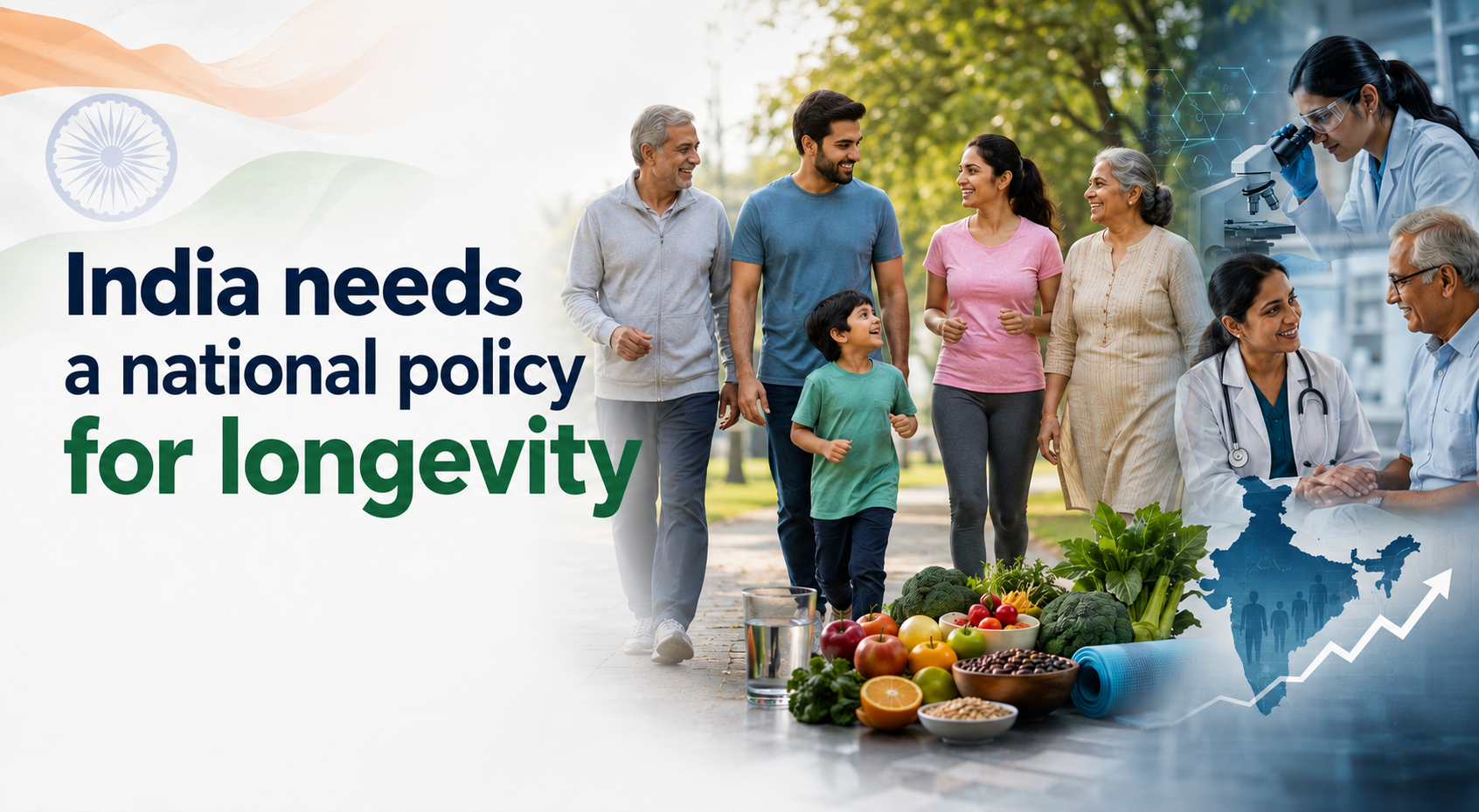
As people are starting to live longer lives and age gracefully, public policy and public expenditure must pivot to preventive healthcare and build social protection. According to the Office for National Statistics UK, today a child can expect to live into their early ninety’s and one in six have a chance of living to 100. This is a steep improvement when historically seen in the 1922, when a 20-year-old had a one in five chance of making it to the age of 80 years. Even by 1972, the odds were one in three. By 2050, India will have 340 million people aged 60 and above, a growth rate 5x that of the general population. By the mid-2040s, the elderly population (60+) is likely to surpass the number of children (0–15 years) for the first time.
Yet, presently 78% of urban nuclear families have no viable care plan for ageing parents, 70% of Indian elderly live with at least one chronic health condition, fewer than 20% have health insurance. Taking 340 million people into a new tomorrow with assurance, love and efficiency, is a challenge staring before public health policy makers. India is only starting to discover proximity into preventive healthcare which ought to have started decades ago.
The quest for an extended healthy lifespan which factors in quality of life has emerged as a critical geopolitical trump card in the light of demographic upheavals, technological breakthrough and international power competition for superiority in health-tech and quality of life. Given the steady growth of India’s ageing population, India needs a national policy for longevity to be rolled out at the earliest. State backed research and scientific efforts to slow biological ageing has triggered a resilience race like never before. Nations that lead in longevity biotechnology could reshape global power dynamics, while others risk demographic decline and strategic vulnerability. A state that fails to provide for quality of life for her citizens, becomes strategically weak in the eyes of its adversaries.
Every year India is adding a sizeable retirement population who retire at 60. This retirement age has been drawn in from the twentieth century policies which are mathematically dead today. Modern life is calling for amendments to current social contracts that hold professionals hostage and force retirement without factoring in productive available years beyond retirement policies. Today life begins for most men and women at 35-40, given their ambitious aspiration to pursue academic grades, to undertake goals where they put themselves first and others later. With years and decades spent on collecting information and degrees, forcing retirement leaves a massive vacuum on acquired wisdom, experience and judgement.
India’s longevity policy must remove the retirement age allowing people to adapt to flexible work days after they turn 60, subject to regular mental health screening and also close monitoring of their own self-discipline based on preventive health and personalized genetic testing. The psychological toll of planning for a short life while scientific breakthroughs are making a 100-year life the new baseline, needs to be factored in while thinking through this policy. The present existing social security safety nets are mathematically incapable of supporting the incoming tide of current young professionals.
What needs to be thought through is a public health policy that shifts ageing from a liability into a massive economic engine where shared experience can lead to faster and more efficient problem-solving possibilities. With India’s fertility rate now below replaceable levels at 1.9 children per woman, longevity will be a strategic political tool for survival besides competing for biological capital.
A national policy on longevity for India would mean healthier populations who drive sustainable growth, greater investments in preventive health and family medicine, forward innovation in robotics care leading to a better quality of life and a more vibrant workforce with shared goodwill. For those worried about allowing older leaders and bosses to continue, the policy must force stepping down at 60 with roles more centered towards training, mentoring and advisory policies, marketing and documentation processes.
India will ought to look at longevity and ageing as a solvable engineering problem and invest in the geopolitics of staying young that would offer agility, foresight and ethical stewardship. The ultimate dividend may not just be longer lives, but a more prosperous, resilient, and cooperative nation, building a steady inter-generational solidarity at the heart of progress.
One of the greatest achievements of the last century was the success at which disease burden was reduced dramatically to suit people to live longer today. To pay it forward, India and other countries would need to enhance public health spending and make significant research investments focused on improving geroscience with focus on therapeutics aimed at ageing better and stronger. Health focused start-ups and health focused non-government organizations must be systematically encouraged and supported with resources by the Government of India to pursue innovative means to build longevity segments. Longevity policy can provide the country with the kind of freedom the citizens seek to achieve, while aging gracefully. Investing in this could be India’s 21st century gift to her people and the world.